


Receiving your university acceptance letter and securing your student visa are monumental victories. However, the true test begins the moment you step off the plane.
Study in the USA in January Intake
Where Ambition Meets Approval
Avoid devastating study permit rejections. Learn the common student visa mistakes driving 2026 rejections in Canada, the UK, and Australia.
How can
we help you?
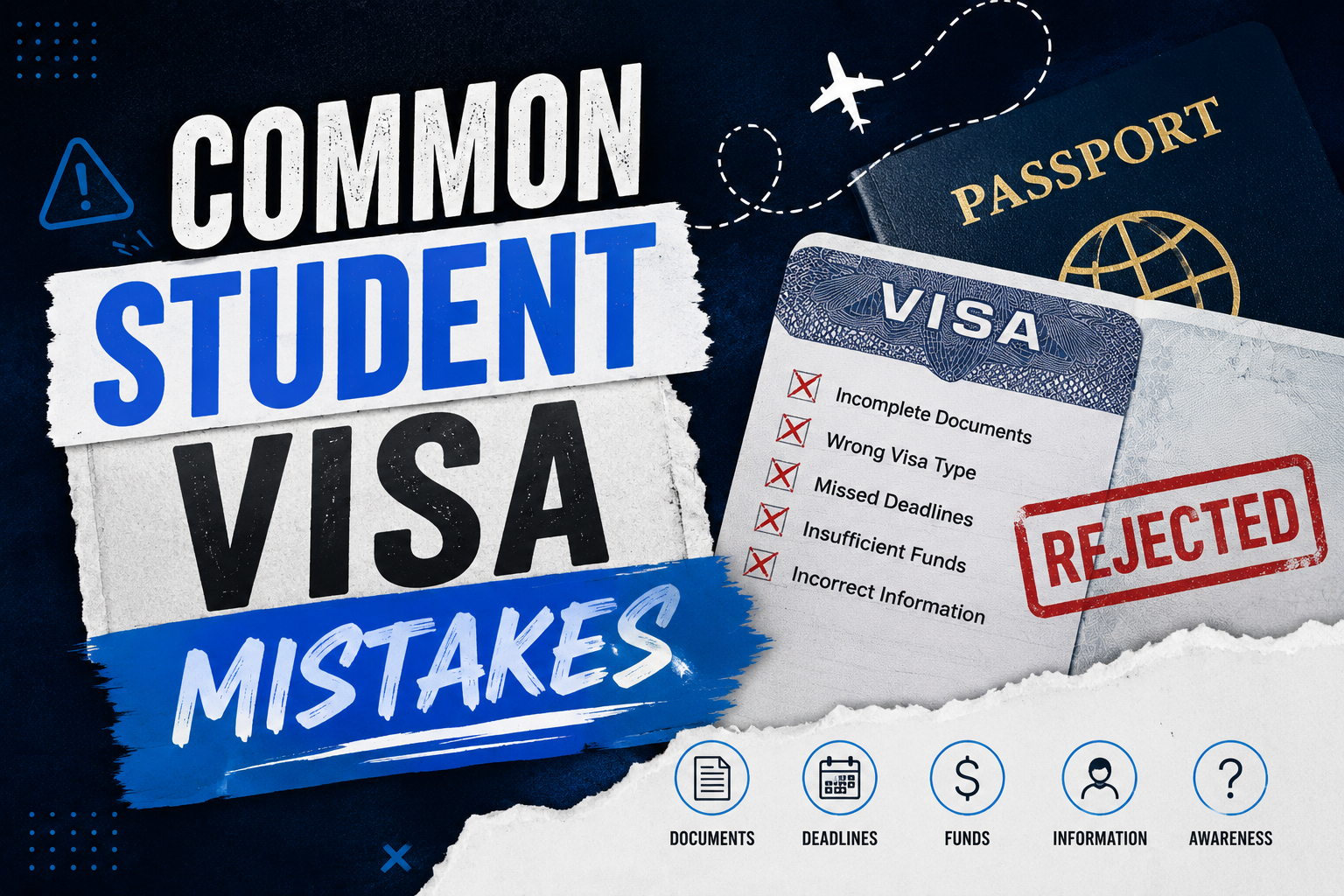
A student visa refusal is more than an academic delay it is a permanent mark on your global immigration record. Every subsequent visa application you make to any country will require you to declare that rejection, creating an uphill battle for the rest of your professional life.
As we navigate the highly regulated immigration climate of 2026, the window for error has closed. Driven by domestic housing pressures and updated labor market mandates, immigration departments across Canada, the UK, Australia, New Zealand, and Denmark are heavily auditing student submissions. Standard checklists are no longer enough. To safeguard your global education, you must understand the common student visa mistakes that are triggering automated and manual rejections this year.
The Shift in Scrutiny: Why 2026 is Unforgiving
Over the past year, major Western nations have implemented structural policy overhauls designed to reduce net migration numbers. Rejections are rarely based on missing basic papers; instead, they stem from nuanced inconsistencies in financial presentation, structural mismatches in academic pathways, and failure to meet updated subjective intent requirements.
To help you secure an approval on your first attempt, we have classified the fatal mistakes into four operational risk zones.
Risk Zone 1: Financial Architecture Faults
Misunderstanding how immigration officers calculate financial liquidity is the number one driver of visa rejections globally.
[The Financial Proof Trap]
Showing Only the Minimum Base Threshold
 ❌ Instantly Flagged for Low Post-Arrival Runway
Presenting Unexplained, Recent Large Deposits
 ❌ Flagged as "Fund Laundering" or Borrowed Capital
1. Failing to Match Updated Country-Specific Funds
Many applicants rely on outdated forum advice or obsolete videos regarding required living expenses. Using outdated calculations will trigger an automatic refusal for insufficient funds.
Australia (Subclass 500): The minimum financial capacity requirement has risen sharply to AUD 29,710 per year for a single applicant, plus the full cost of your first year's tuition.
United Kingdom: You must show exactly £1,529 per month for courses in London or £1,171 per month for courses outside London, held continuously for a strict 28-day cycle.
Canada: The single-applicant cost-of-living financial threshold sits at CAD 20,635, completely separate from your tuition fees.
2. The "Sudden Cash" Phenomenon
Depositing a massive lump sum of money into your sponsor's bank account a few days or weeks before submitting your visa file is an immediate red flag. Visa officers look for a clean, traceable 3-to-6-month account history. If a large sum appears without an undeniable, legally documented paper trail (such as a registered property sale or a cleared tax return), the officer will conclude the funds are temporary or borrowed strictly to pass the visa check.
Risk Zone 2: Subjective Intent and Structural Mismatches
In 2026, looking like a "genuine student" on paper requires deep alignment between your past career and your future degree.
3. Fumbling the New Genuine Student (GS) Metric in Australia
Australia completely replaced its legacy GTE framework with the Genuine Student (GS) requirement, turning the assessment into a highly precise metric. A generic Statement of Purpose (SOP) that praises the university’s campus layout or lists general tourism spots will cause an immediate rejection.
The GS metric requires you to explicitly prove how this specific Australian course fits into your home country’s economic realities, detailing local wage returns, industry deficits, and your precise employment roadmap upon return.
4. Ignoring Field-of-Study Restrictions in Canada
Under Canada's updated study permit cap architecture, non-degree applicants (those seeking undergraduate diplomas or certificates) face highly restricted streams. If your chosen diploma program does not align precisely with designated national labor shortage codes, your file is at extreme risk. Furthermore, failing to secure a valid, real-time Provincial Attestation Letter (PAL) or Territorial Attestation Letter (TAL) where required results in an immediate administrative voiding of your application.
Risk Zone 3: Document Compliance and Age-Cap Omissions
The technical execution of your visa file must be flawless. Minor oversights are treated as material non-compliance.
5. Overlooking the New Age Constraints
Age limits have become hard boundaries in specific jurisdictions.
Critical Warning for Australia: The age limit for the Post-Higher Education Work stream has dropped to 35 years of age or under for course-based graduates. If you are over 35 and applying for a standard course-based Master's degree, visa officers will evaluate your genuine student intent under extreme scrutiny, knowing you cannot transition onto a standard graduate work stream post-qualification.
6. Submitting Non-Approved or Expired Language Credentials
With Canada demanding mandatory language verification checks across its streams and the UK enforcing strict B2-level English requirements for its work bridges, utilizing a non-approved testing center or an expired test report form is an immediate cause for refusal. Ensure your test fits within the highly specific list of acceptable formats (such as IELTS Academic, PTE Academic, or specific TOEFL iBT streams) approved by your destination country's immigration department for 2026.
The 2026 Country-Specific Failure Matrix
Target Country | Fatal Common Mistake | Immediate Systemic Consequence |
|---|---|---|
Canada | Using an expired PAL or selecting a non-degree major outside labor shortage lists. | Application returned or refused under the 2026 cap quotas. |
United Kingdom | Account balance dipping below the £1,529/£1,171 monthly matrix on Day 27 of 28. | Mandatory structural rejection; no officer discretion allowed. |
Australia | Copying an SOP template or applying for course-based programs if over the age of 35 without a robust career justification. | High-probability refusal under the updated Genuine Student (GS) framework. |
New Zealand | Inability to verify the legitimate source of income for third-party extended family sponsors. | Application flagged for non-genuine funding and rejected. |
Denmark | Enrolling in a non-state-approved public institution, assuming it carries family accompaniment rights. | Immediate denial of partner work permits and student part-time rights. |
Advanced Insights: The Biometric and Digital Footprint Trap
Many applicants fail to realize that immigration departments across the Five Eyes alliance (Canada, UK, Australia, New Zealand, and the USA) share biometric data and application history registries.
If you stated on a previous tourist visa application to the US that you were a senior manager with ten years of experience, and then state on a Canadian study permit application that you are an entry-level worker seeking retraining, the system will instantly flag the data contradiction. Your digital and physical footprint must remain entirely consistent across all historical visa submissions globally.
Your 5-Step Visa De-Risking Protocol
Enforce a 4-Month Account Seasoning Period: Ensure all funds used for visa validation are settled, transparent, and accompanied by undeniable tax records or source documents.
Conduct a Structural Progression Audit: If you hold a Bachelor's degree in Business, do not apply for a Diploma in Hospitality unless you can document a multi-year employment change that mathematically justifies the shift.
Draft a Evidence-First Statement of Purpose: Ban all generic phrasing. Replace sentences like "I want to study in the UK because it is a developed country" with localized data, career market salary statistics, and clear return-to-home-country incentives.
Verify Institutional Status: Ensure your provider sits firmly on active approval lists (such as Canada’s DLI list with PGWP eligibility or Denmark’s state-approved registration portals).
Utilize Professional Risk Assessment: Before submitting your life savings and your professional future to an online portal, pass your file through a senior strategist who understands daily visa adjudication trends.
Frequently Asked Questions
Can I reapply immediately if my student visa is rejected?
Technically, yes. However, reapplying without structurally altering your file or directly addressing the specific refusal codes noted in your rejection letter will lead to a rapid second refusal. You must explicitly counter the visa officer's rationale with new, legally binding evidence.
What counts as verifiable proof of funds for 2026 visa applications?
Acceptable proof typically includes liquid funds held in savings accounts, fixed deposits with a clear maturity history, verified bank loans explicitly sanctioned for international study, and government-funded scholarships. Shares, mutual funds, volatile crypto assets, and unregistered gold evaluations are generally rejected as primary liquid proof.
Does getting a university offer guarantee my student visa approval?
No. An offer letter or Confirmation of Enrolment (CoE) simply proves you meet the university’s internal academic entry standards. Immigration departments operate under an entirely separate legal framework focused on national security, financial compliance, and immigration integrity.
How do visa officers catch fake or doctored financial documents?
Immigration departments employ specialized verification units that work directly with central banking networks, tax agencies, and local registration boards. Presenting a falsified document will result in an immediate visa denial and a mandatory 5-to-10-year ban for material misrepresentation.
Build a Flawless Legal Submission
Securing your student visa in today's immigration landscape requires moving beyond basic forms and treating your application as an elite legal defense. When the stakes involve your career, your financial investments, and your global mobility, relying on guesswork or surface-level templates is a risk you cannot afford.
Our senior advisory firm provides end-to-end, forensic study abroad consultant visa support. We audit your financial architecture, optimize your genuine student narrative, and align your profile with real-time 2026 regulations to maximize your probability of success. Contact our compliance advisors today to schedule your comprehensive pre-submission file review.
Innovative
solutions
Latest Blogs
Common Student Visa Mistakes: 2026 Avoidance Guide
Avoid devastating study permit rejections. Learn the common student visa mistakes driving 2026 rejections in Canada, the UK, and Australia.

How to Choose Your Study Abroad Destination: Strategic 2026 Decision Guide
Key factors every student should consider.